We use cookies to help you navigate efficiently and perform certain functions. You will find detailed information about all cookies under each consent category below.
The cookies that are categorised as "Necessary" are stored on your browser as they are essential for enabling the basic functionalities of the site....
For more information on how Google's third-party cookies operate and handle your data, see: Google Privacy Policy
Necessary cookies are required to enable the basic features of this site, such as providing secure log-in or adjusting your consent preferences. These cookies do not store any personally identifiable data.
Functional cookies help perform certain functionalities like sharing the content of the website on social media platforms, collecting feedback, and other third-party features.
Analytical cookies are used to understand how visitors interact with the website. These cookies help provide information on metrics such as the number of visitors, bounce rate, traffic source, etc.
Performance cookies are used to understand and analyse the key performance indexes of the website which helps in delivering a better user experience for the visitors.
Advertisement cookies are used to provide visitors with customised advertisements based on the pages you visited previously and to analyse the effectiveness of the ad campaigns.
Other uncategorised cookies are those that are being analysed and have not been classified into a category as yet.
Discover how our brushless DC motor controllers enable precise movement and monitoring of machine axes, their advanced motion control features, and seamless integration with Rotalink motors for highly dynamic precision drive systems.
In the realm of automation technology, a brushless DC motor controller – also known as a position controller – finds application in precisely guiding and monitoring one or more axes within a machine. These positions are handled sequentially, meaning that the subsequent processing step occurs only after the previous target position has been accurately reached.
The brushless DC motor controller oversees the positioning process, transitioning from one position to another or a sequence of positioning actions based on a path diagram. Hence, it is also referred to as feedforward control or path program control.
Utilising rapid counter inputs designed for incremental or absolute encoders, the brushless DC motor controller detects the current position and speed of the respective axis. It then employs this information alongside the target position to calculate the control deviation, a concept known as motion control. A brushless DC motor controller can encompass a wide array of additional functionalities, such as message reception, generation, and processing, position value handling, and travel range limit monitoring.
These axes can be actuated through electrical, pneumatic, or hydraulic means. The most prevalent approach involves governing servomotors or stepper motors. In scenarios involving multiple axes, a primary intelligent control unit typically assumes the role of coordination, communicating with lower-level systems through a standardised interface, typically field- or Ethernet-based bus systems.
A standalone version can independently manage entire single-axis systems through self-created sequence programs, eliminating the need for a primary intelligent control unit. Positioning controllers can be independent devices, integrated as hardware or software modules within a PLC, or integrated into the control software of actuators or drive controllers. The control can take the form of point control or a significantly more intricate spatial path control.
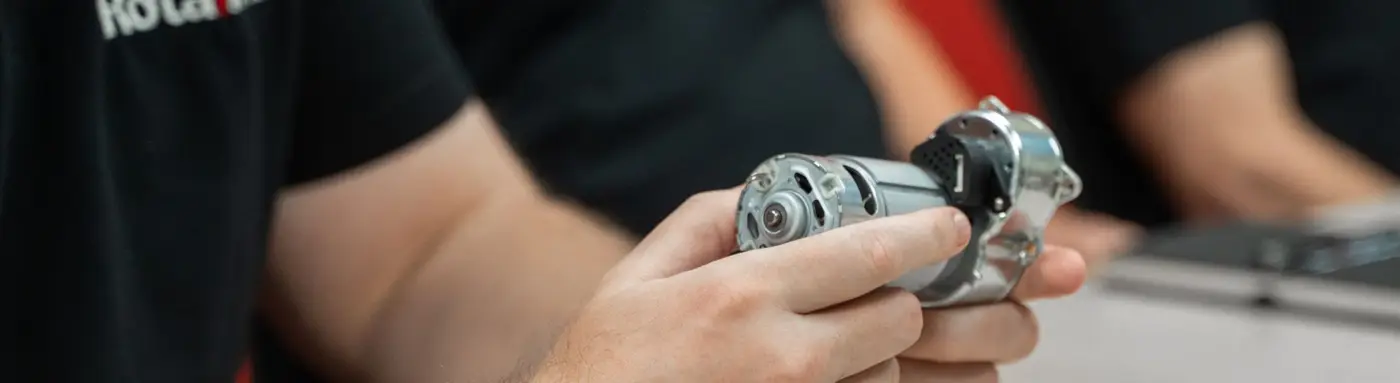
When combined with Rotalink motors, brushless DC motor controllers deliver precision drive systems capable of executing highly dynamic movements.